
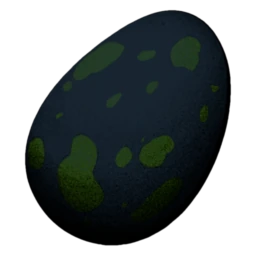
Deinonychus Egg
Tremendously nourishing by itself, this egg provides regular nutritional value in many cooking recipes.
Details
- Category
- Egg
- Games
- ASE + ASA
- Expansion
- Valguero
Maps
Found on 2 maps
Related
Video guides: search YouTube for Deinonychus Egg guides
How to get Deinonychus Egg
Deinonychus Egg is dropped by 1 creature.
Dropped by
 Deinonychus
 Egg — Detailed Guide
A Valguero egg with two names
This egg comes from the  Deinonychus, and our records list it on Valguero. ARK: Survival Ascended calls it the Fertilized Deinonychus Egg, while ARK: Survival Evolved lists it as the
 Deinonychus Egg. In-game it reads: "Tremendously nourishing by itself, this egg provides regular nutritional value in many cooking recipes." It can be eaten, used to make kibble or hatched into a baby Deinonychus.
Breeding and nest raids
Two Deinonychus that have mated produce the egg, and the female then needs between 18 hours and 2 days before she can lay again.  Deinonychus Nests are another source, though taking an egg while wild Deinonychus are around turns them hostile. The ARK Wiki counts it among five eggs that can come both from a nest and from breeding two tamed parents; the others are the
 Rock Drake Egg,
 Wyvern Egg,
 Crystal Wyvern Egg and
 Magmasaur Egg.
Hatching a Deinonychus
Incubation takes 4h 59m 58.561s. The egg must stay between 80 and 90 °C (176 to 194 °F), or it begins to lose health. An  Egg Incubator set to the ideal temperature can shorten this by up to 20%. The wiki also recalls that when Valguero launched, eggs in nests often hatched on their own in the ambient temperature, until patch 297.35 stopped eggs from hatching inside the nest.
Kibble in each game
The kibble it makes depends on the game:  Extraordinary Kibble in ASE,
 Regular Kibble in ASA. The ARK Wiki names creatures tamed with Extraordinary Kibble, such as the
 Yutyrannus,
 Thylacoleo,
 Shastasaurus,
 Megalania and
 Griffin. Unlike the Yutyrannus egg, an unfertilized Deinonychus egg is no use for that kibble, as the Deinonychus lays a
 Raptor egg instead. Our records give the egg a weight of 6 and a spoil time of 8 days (192 hours).